
Ebbie
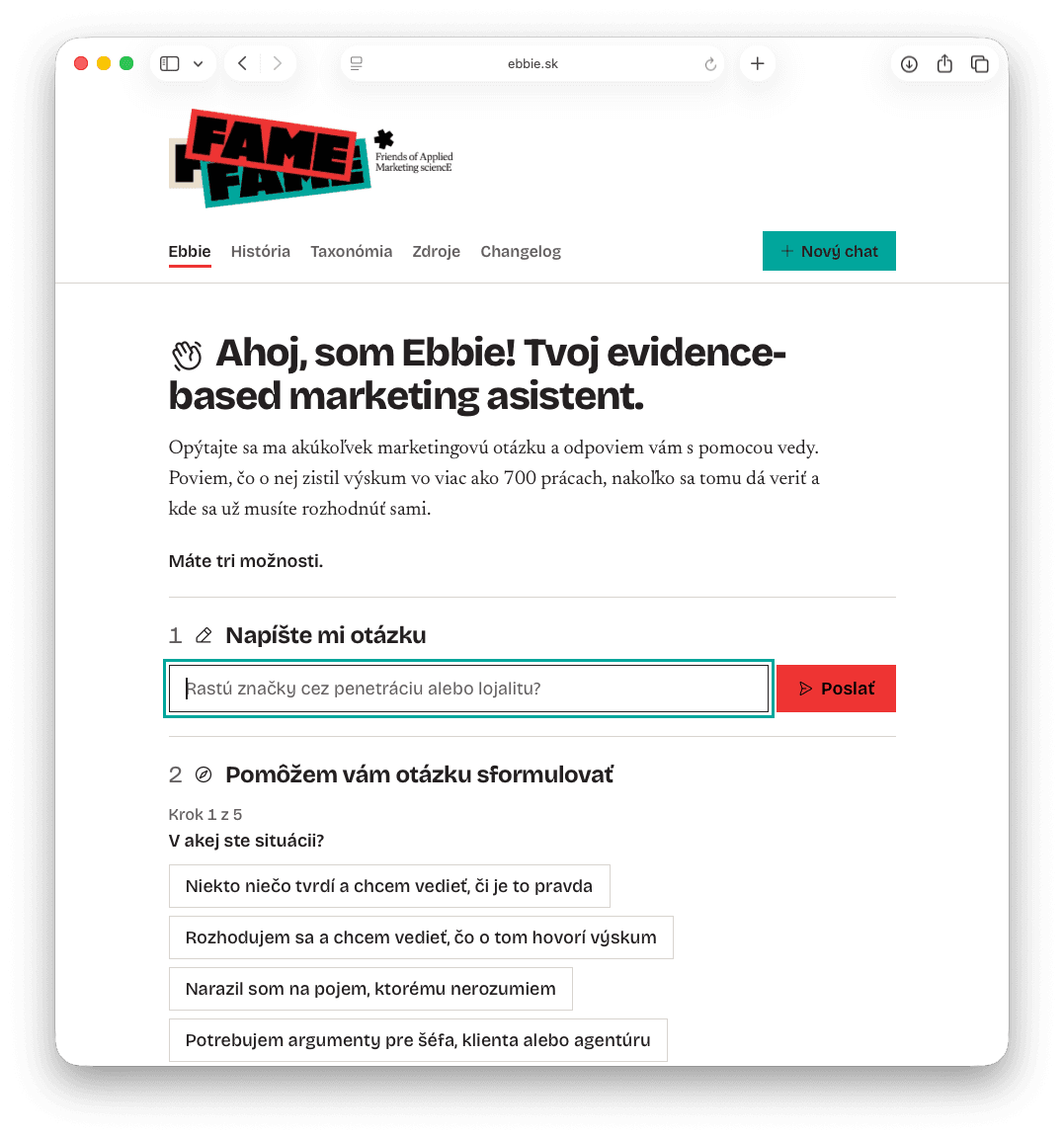
FAME’s AI assistant, answering from a curated library of scientific and professional sources. It relies only on verified sources rather than random internet results.
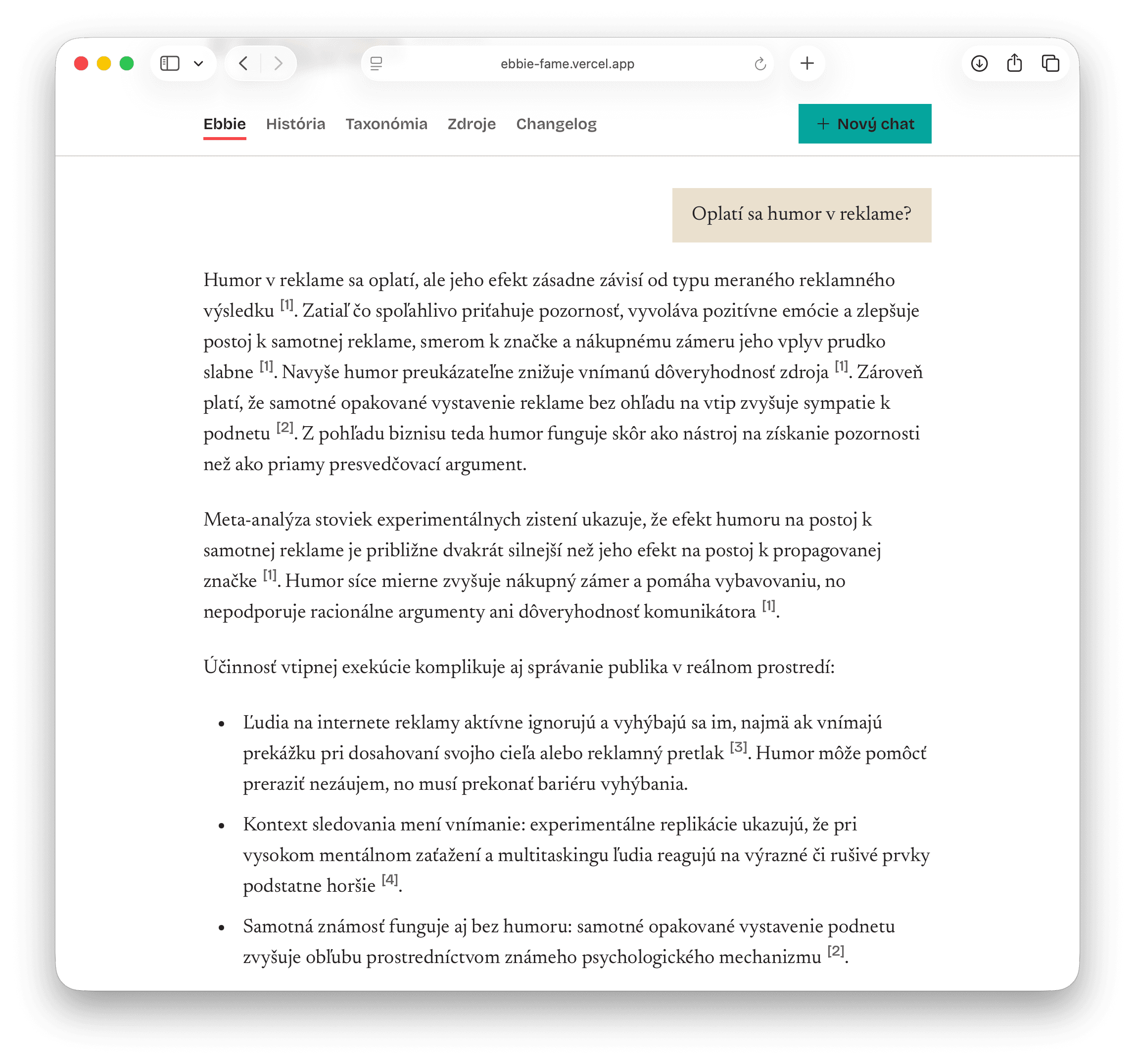
Does humour pay off in advertising?
Finds relevant research for the topic you are working on
Write your own question, choose from the prepared topics or get help formulating it for your situation, market and brand size.
Assesses the strength and limits of the available evidence
It distinguishes study type, independent verification and conditions of validity. It flags contradictory findings and a lack of evidence for your market.
Builds an argument for management, a client or colleagues
Put forward a claim you want to test. Ebbie separates the supported core from the hypothesis and explains the conditions under which the claim holds.
Provides material for a presentation that stands up to scrutiny
It connects answers to studies and bibliographic details. You can ask about a specific finding, its limits or its implications for practice.
Suggests follow-up questions
Below the answer, it offers questions that help you explore the topic further or consider it from another angle.
Saves the answer at a link you can share
Every answer has a permanent link. You can send a colleague or client the full answer, including its sources.
Along the way, it teaches you to tell whether you are reading a meta-analysis, a case study, a commercial report or someone’s opinion.
Open EbbieFAME members have full, unlimited access to Ebbie. Non-members can have 10 conversations with it each month, with at most 10 questions in each.
Frequently asked questions
What is in the library behind Ebbie?
Peer-reviewed scientific articles, books, conference papers, preprints and professional reports. Topics include buying behaviour, brand growth, mental and physical availability, advertising and its measurement, pricing, loyalty and B2B. You can browse the list of works directly in Ebbie. We are preparing a glossary for marketing practice.
How does Ebbie assess evidence?
It separates the type of publication from the verification status of a finding. For sources, it distinguishes peer-reviewed articles and meta-analyses, books and non-peer-reviewed reports. For conclusions, it uses the available information on independent confirmation, conditions of validity, limited verification and contradictions. If replication information is missing, this does not mean the result has been independently confirmed. A journal’s prestige alone does not tell you whether a result applies to your situation.
What can Ebbie not do?
Ebbie does not search the entire internet and has no access to your company data. It can suggest how to test a finding in your organisation, but it will not carry out the measurement for you. If the library lacks sufficient evidence or the findings concern a different market, it should say so in its answer. Even an answer with citations can contain an error; for important decisions, open the original work.
How can I suggest a source for the library?
Send us the title, authors, link or DOI and briefly explain which marketing question the source helps answer and why. Send your suggestion to our contact email.